Showing posts with label Dave McKean. Show all posts

Thursday, August 19, 2010

More Of My Unseen Films Writing, & Twitter Stuff

So as I sit here about to embark on some more editing of upcoming posts on Unseen Films, I figure I'll post here another of my contributions to that site, which appeared there in late April, 2010. It concerns a short film collection by a favorite artist of mine, Dave McKean, who I'm really hoping to meet someday. I just found out earlier today that a Twitter friend who lives in the same county of England as McKean will be attending a symposium in which he will "explain his working practices and processes", which I really hope is being filmed for a DVD or iTunes U release.

And on a nearly unrelated note, I found out today that Trace Beaulieu, original member of Mystery Science Theater 3000 and now co-conspirator in Cinematic Titanic (both of which will be featured in upcoming posts on Unseen Films), is now following my Tweets on Twitter! That came as quite a shock, but definitely an honor, as his work on both of those projects, along with his cohorts on each, has had me laughing for 20 years now. Really was quite thrilled to see that e-mail saying he was following me, very cool!

Anyway, enough rambling, here is my write-up of Dave McKean's Keanoshow;


The opening of the 15 minute short film “Kodak: Take Pictures Further“ contains the following lines written across the screen; “My head hurts. I’ve got too many images in my brain. Quick, somebody get me some more film before my head explodes.” Welcome to the world of Dave McKean.

The visual work of McKean, particularly his motion picture work, requires that you pay attention at all times. Being a visual artist first, his films are filled with bizarre imagery that may or may not be representative of anything, but are still a treat to look at. For those unfamiliar, McKean was the cover artist on the entire run of Neil Gaiman’s “Sandman” comic book series, and also was the director, designer, and co-storywriter of the film “MirrorMask” (Gaiman was the other storyteller). One of the things that is consistent about McKean’s work is that you can never be quite certain of just exactly what it is you’re looking at. Even if you think you do know what you’re seeing, quite often it will metamorphose into something else in a graceful and oftentimes surprising way. He also tends to combine images in a way that juxtaposes them wonderfully. He will alternate between a fixed camera position, with interesting images literally unfolding before the eyes, to giant sweeping arcs in and around computer creations seemingly floating in the ether. McKean never fails to visually dazzle the viewer. Some of the short films on “Keanoshow” don’t even center around a narrative per se, as much as they are just about stunning visuals.
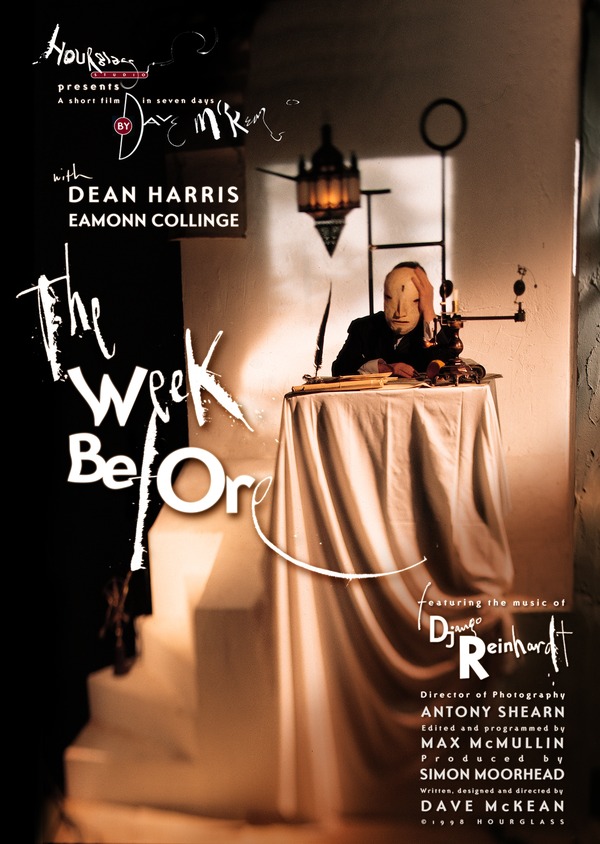


As far as narratives, my personal favorite film on the disc is “The Week Before“, about the seven days leading up to the week in which God created the world. Featuring the music of Django Reinhardt (which is apparently the reason for the unavailability of “Keanoshow” in the US), we follow God (portrayed by Dean Harris wearing one of McKean’s trademark masks) as he works his way thru seemingly ordinary days of naming objects, fishing, and playing cards with his neighbor (who, since the world hasn’t been created yet, is The Devil, played by Eamonn Collinge in another of McKean‘s beautiful masks). It’s a lighthearted look into a life, made rather dazzling by the combination of live actors wearing some of McKean’s art, existing in worlds that are part physical set and part McKean’s computer art. It always seems interesting to me to see McKean’s paintings come to life, and that is in a nutshell what “The Week Before” is, more so than any of the other shorts on “Keanoshow“. “The Week Before” is also probably closest of anything on the disc visually to “MirrorMask“, and the excellent choice of Reinhardt tracks to accompany the days of the week makes for a truly engaging 23 minute film. It was actually the music of Reinhardt that inspired McKean to write many of the scenes for the film.

“n[eon]” contains a line that is very appropriate. Although the lead character, voiced by narrator John Cale, is talking about Venice, Italy (which is where McKean wrote the short) when he utters the line, he could well be talking about McKean’s work in any medium when he says “(It) rewards those who pay attention. The more you look, the more you see.” This is perhaps the most surreal, dream-like piece on the disc, which is saying something considering it’s context. It may also be the best piece on the disc. A seemingly somber short, you find your self thinking, a lot, as the film unfolds. A man searching for where he belongs wanders Venice and sees a ghost, as he wonders about his place in the universe. Obviously, there’s much more to it than that, but the 28 minute film has to be seen, not explained.

“Whack!” is a 14 minute live-action adaptation of the Punch & Judy puppet shows; just as violent, and perhaps more disturbing, in real life. The entire film takes place inside the tent that the puppet shows would be presented from, so the overly close perspective adds a bizarre quality to the visuals, making everything, even though comedic, seem more intense (no pun intended). The actors are members of Forced Entertainment, an experimental theater group in England.

“Dawn” is a 9 minute film made in 3 days because McKean wanted to remember that making films was fun, after spending 2 years making “MirrorMask” where it had become a tremendous amount of work. It stars his daughter Yolanda and is based on “conversations with (his) worrisome daughter”, and, while not featuring the look of his artwork, is visually unique in that it was shot on video thru glass bottles to add a sort of dream-like quality.

“Displacements” seems to exist solely for the pleasure of being able to create interesting images on computer for the camera, interspersed with snippets of an interview with Michael Moorcock that are layered and looped in to become another visual element of bizarreness. McKean is fond of distorting audio, leaving in scratchy noises that sound like a German Expressionist film looks.

There are also a dozen more short films included, varying in length from 1 to 15 minutes. These include music videos for artists as diverse as guitarist Buckethead (featuring Les Claypool on bass & vocals), opera singer Izzy, and a live performance at a jazz club by Iain Ballamy and Stian Carstensen, which McKean later added visual effects to. The music video seems to be a perfect format for McKean; I personally would love to see him add to his repertoire in this genre. He’s done well over 150 CD covers, it seems only natural that he would progress to this medium. Of the rest of the films, an especially interesting one is “A Short Film For Adobe“, in which the company’s Photoshop program is demonstrated within the context of a photo shoot in a rather clever way. Also of note is a short adaptation of part of “Signal To Noise“, originally done as a series for Face magazine, and then collected into a graphic novel, written by Gaiman and released back in 1992. A conversation shot in a living room from a single camera angle is transferred into a visually arresting image with the collage of images coming together to form the whole. Much like a lot of McKean’s work, in any medium, it needs to be seen, as it is rather difficult to explain…however, it is all very much worth it indeed.

It is also worth noting that much of the music for many of the films on “Keanoshow” is written and performed by McKean himself. Even the basic DVD menus are done in McKean’s style, making the entire disc a treat for fans of his work. There is an interview with him in which he discusses some of the work seen on the disc, and even that is infused with some of his artistic sense. McKean is a very talented visual artist in whatever medium he chooses to work in, having a very distinctive style which is on full display in this collection of short films directed and designed by him spanning a nearly 10 year period. As mentioned earlier, the copyright issue over Reinhardt’s music currently prohibits a release in the US, but it looks to be getting a release in Europe from Darkside in the next few months (this information direct from McKean himself via his Twitter account…well worth following, as his taste in film mirrors much of what appears on this site, and he often reports on his family‘s choice of film the night before). “Keanoshow” was very briefly available on Amazon in the US in late July, 2008, which is how I got my copy, but quickly became unavailable from them when the copyright issues arose. You can find it on eBay and things like that, and for those with a taste for visual flair who are willing to try something a bit different, you shouldn’t be disappointed…as long as you pay attention.

Special thanks to Dave McKean for the info and the images, and for being a pretty cool guy, as well as a helluva artist.


Blog Post Soundtrack; much of Tomahawk's self-titled debut album...for those who don't know, this was Mike Patton's first major post-Faith No More project, excellent stuff...and of course, whatever I was listening to as I was originally writing the piece for Unseen Films, but I bet there was some Django Reinhardt in there...

Friday, August 13, 2010

How To Fill A Large Amount Of Space In A Small Amount Of Time

I'm still really busy, working many, many hours. I don't have a life, but with all of the money I've been making working all of this overtime, I plan on buying myself a really nice one eventually. So, in an effort to keep this blog contributed to on something approaching the semi-regular basis as proclaimed in the title, I've decided I'm going to cut-and-paste my contributions to my buddy's blog Unseen Films over to here. These are all things that I've written this calendar year, so well within the time frame of starting this blog. I wouldn't mind these pieces getting a little more exposure, and I certainly wouldn't mind helping to plug my friend's blog as well. He's insane; his blog has been going for 6 months with a MINIMUM of one entry PER DAY, giving small write-ups to films that deserve a little more attention than they are receiving. When he finds time to work and/or sleep I have no idea, what with him watching all of these movies, then writing about them as well. He's a true film devotee, really loving the medium, always willing to watch anything in the endless search for things worthwhile. Which, unfortunately, also means that he spends countless hours watching drek and garbage as part of that quest for film gold. You know those crappy movies they make fun of on Mystery Science Theater 3000? He owns many of the uncut originals...

So, that's my rather long-winded way of introducing the first of my Unseen Films contributions, posted back in April, 2010 about MirrorMask, a beautiful little film by Dave McKean and Neil Gaiman, a favorite artist and author pairing of mine. My write-up is preceded by an introduction about McKean by the Overlord Of Unseen Films, dbborroughs. The introduction also has a brief explanation about myself, as this was my first published contribution to Unseen Films.

On with the show!

This weekend Unseen Films is going to take a look at a feature film and a collection of short ones by artist and filmmaker Dave McKean. McKean is probably best known for his comic work with Neil Gaiman. However McKean doesn't limit himself to any one medium and has produced amazing work in a variety of fields. One of the fields he works in is the realm of the moving image on film and video. Today we'll be looking at the feature film he created with Neil Gaiman and the Jim Henson Company called MirrorMask. Tomorrow we'll be looking at a compilation of his short films called Keanoshow.

McKean is one of the few filmmakers working today who's use of computer generated imagery makes sense. Here is a man who has been using the medium probably since the beginning and he knows how to make images that truly look real. Most Hollywood super productions spend millions of dollars on expensive graphics and when you look at them, and I mean if you really look at them, you can see that what you are seeing isn't real. Worse if it does look real it never integrates into the live action portions of the film.
That doesn't happen with McKean.

What I love about McKean's work is that he doesn't use just movie tricks. He is a filmmaker who will use anything at his disposal. If one looks at his film you'll see a variety of styles and methods used. There are puppets and image collages and masks and costumes and props and computer generated gizmos. There isn't a limit to what he will use. He is very similar to true cinema masters like Jan Svankmajer or Hans-Jürgen Syberberg, who use a variety of techniques to get their stories told. I'm sure that the use of a variety of techniques comes from a lack of funds but at the same time it forces the artist to be much more clever and inventive.

McKean's visuals are works of art.
To be able to truly speak about Dave McKean's work seemed a bit beyond me. Honestly I didn't feel I could do them justice, so I've asked a good friend of mine and Unseen Films contributor Ken Fries to take over control for this weekend and really explain why McKean's work is so special. He is much better suited to get at the meat of the material than I am, since he's been a fan of McKean for longer than I have.

Before we get to the review itself I want to explain why not only I asked Ken to come aboard here at Unseen Films but also why he's the perfect person to review this weekend's films. Ken is a man of many interests, chief among them are film and art. With film he's the sort of person you can make an off the cuff reference to a film to only to find you end up in a two hour conversation about a variety of related films and subjects. It's never one thing its everything all at once. Not so long ago, before a few detours, Ken wrote regularly on comics and comic art for several publications. He was responsible for some of the earliest extended and meatiest interviews with people like Hellboy creator Mike Mignola. And when I say meaty, I mean meaty. He once interviewed illustrator Charles Vess for Comics Journal but the interview was so long and detailed that the magazine sent some one else to interview him because the act of transcribing it and getting it ready for publication was going to have the issue whiz past deadline. (The still unpublished interview is one of the best and most detailed you're ever likely to see on an artist.) Ken loves to make sure he's right on every detail which is what makes reading him so much fun. He's a guy who knows what he's talking about, and knows so much that odds are that even if you know a subject you're going to learn something from him.

With that in mind I'm going to pass control of Unseen Films over to Ken for his take on the works of Dave McKean.


Watching MirrorMask is like watching someone’s dreamscape gently drift across the screen. In this case, the someone happens to be the very talented artist Dave McKean, and the dreamscape, however bizarre, has a narrative, courtesy of Neil Gaiman. McKean has the ability to take the world of his dreams and visually transform it into something tangible for the screen, which isn’t an easy thing to do. Have you ever tried describing your dreams to someone? While it may make sense to you, the look on the face of the person you’re describing it to says something to the effect of “Why are you continuing to babble on about whatever meaningless nonsense this is? Please stop…” In this case, you wish for this world to continue endlessly.

The story is co-credited to Gaiman, who also gets screenplay credit. And while Stephanie Leonidas, who wonderfully plays the young girl Helena, along with Jason Barry and Rob Brydon, receive top billing, truth be told, it’s the visual unreality designed & directed by McKean that is the real star of the film. Helena is a mid-teen whose family owns & operates a small time one-ring traveling circus, and she wishes to run away and join real life. The colorful world she unhappily inhabits is disrupted by an argument with her mother in which harsh words are exchanged, followed almost instantly by the mother collapsing, being hospitalized, and in need of surgery. We are suddenly transported to a cold antiseptic grey block of flats where Helena lives, as she feels guilt over the exchange with her mother. She visits her Mum in an equally cold antiseptic grey hospital. All color and life has been removed from the visuals to a very great effect.

As Helena goes to sleep on the night of her mother’s operation, she awakens to McKean’s dream world, the visual cacophony that brings the film back to a vivid Technicolor life. The dream world she inhabits is a metaphor for what’s going on in her life, much like someone’s actual dreams are. It’s just a treat to see it translated so beautifully to the screen. Books are used as transportation devices, not in a metaphorical but a literal sense. Schools of fish swim by in mid-air, alongside people walking around who all wear masks, and look oddly at Helena for she doesn’t have a “proper face”, as she’s not wearing a mask. Talking winged cats with human faces threaten her. The entire dream world is a manifestation of Helena’s artwork (which is the art of McKean), which she draws to amuse herself, as well as to give to her Mum when she visits her in hospital as homemade get-well cards. All of these elements are presented in a stunning visual world that is a CGI transformation of McKean’s artwork, while the masks are also McKean creations.

The rest of the story concerns Helena's quest for the film's title, as it can be used to awaken the Queen of the City Of Light, and in turn return Helena to her real world. While the quest aspect of the story isn't exactly breaking any new ground, it's the visually exciting and beautiful way in which it's presented that makes the film so interesting to watch.

The DVD is packed with extras, including an extremely interesting and informative feature-length commentary by both Gaiman & McKean, sitting in the same room at the same time, so it’s a conversation, not just a mere recitation of facts. Made on an insanely modest budget of roughly four million dollars, this is an obvious labor of love that is an absolute treat for anyone who is already a fan of McKean’s artwork. For those who aren’t familiar with his work, but like things like Labyrinth (which in part inspired this film), this will be a delight as well. If you have an appreciation for a fascinating visual world, and always wanted to know what dreams would look like if they were brought to the screen (and would also like to see a librarian made partially out of books and voiced by Stephen Fry), this will be an enjoyable film. Just see if your dreams become any more interesting after watching this film.


Blog Post Soundtrack; Sly & The Family Stone, Mother Love Bone, Cavalera Conspiracy, Parannoyd, Metallica (live), The White Stripes (live), ZZ Top, Sid Vicious (live), Foo Fighters, Infectious Grooves, Tool, MirrorMask by Dave McKean, and whatever may have been playing at the time when I was writing up the review many months ago...

Sunday, April 25, 2010

Unseen Films & Backhanded Compliments

So my write-ups on the film work of Dave McKean appear this weekend on my friend's blog, Unseen Films. When the hell he finds time to watch all of this stuff, then do write-ups about the ones he likes (because believe me, there are many more pieces of drek he doesn't waste time writing about, but he's watched those too), is beyond me. He has a full time job, plus goes into Manhattan on average more than once a week to see shows on and off-off-off-Broadway. And he still finds time to maintain relationships with a circle of friends both on and offline.

Anyway, he asked me to do some work for the site on things he knew I would be keen to do. In addition to allowing me to do the McKean films, I'll be having a week in July for quasi-British comedians (Bill Bailey, Dylan Moran, Tim Minchin, maybe more) who are deserving of far more attention, mostly in this culturally depraved nation we know as the United States. Eddie Izzard seems to have successfully crossed over from European success to widespread fame in the US, but there are plenty others who are equally deserving of having their intelligent and insightful, not to mention damn funny, material noticed...hey, when did this soapbox appear under my feet...

I should also thank McKean for posting a link to the write-up of MirrorMask on his Twitter feed (which at this point has nearly 13,000 followers), and for providing me with an image to use in the write-up of his short film DVD collection, Keanoshow. Maybe some of these films will be a little less unseen now.

One more quick thing; I got an e-mail from my Mom this morning in regards to my writing on the McKean films. While not as funny as Justin's Dad, it's still worth repeating;

"I’m sure you are aware that I have no idea what you are talking about but you write so well that it may seem as though I know a little something by the time I peruse all this material."

...Thank you?


Blog Post Soundtrack; Blondie, Rage Against The Machine, The White Stripes, MC5, The Doors, Queens Of The Stone Age